 There’s more to lighting efficiency than the light source, says Stewart Langdown of Ceravision
People in the lighting industry, including myself, have a tendency to refer to types of lighting in relation to the light source being used – HID lighting, fluorescent lighting, LED lighting, plasma lighting etc. And while I’m not suggesting this should change, I do believe there is a tendency to equate a particular light source with a particular level of energy efficiency. This, I believe, is something we need to be wary of.
The fact is while the light source certainly makes a major contribution it is the overall package that determines both lighting performance and energy efficiency. This is because the majority of luminaires are an assemblage of components from different manufacturers – lamps, control gear, reflectors, diffusers etc. Clearly they’ll be compatible with each other, but that’s not the same as complementing each other’s’ performance. Indeed, there have been cases where various components have actually impaired the performance of other components. For instance, a badly designed luminaire with poor thermal management will prevent the LED light sources from performing at maximum efficiency – and shorten their life.
High efficiency plasma lighting
 Consideration of the whole package is the basis of Ceravision’s high efficiency plasma (HEP) lighting, a less familiar technology than some perhaps, but one that has been around for many years. It is only recently, though, that this technology has been packaged into a practical solution for a wide range of lighting applications.
A big difference with HEP lighting is that all of the components have been developed by the same engineers at the same time and work in harmony to deliver optimum results.
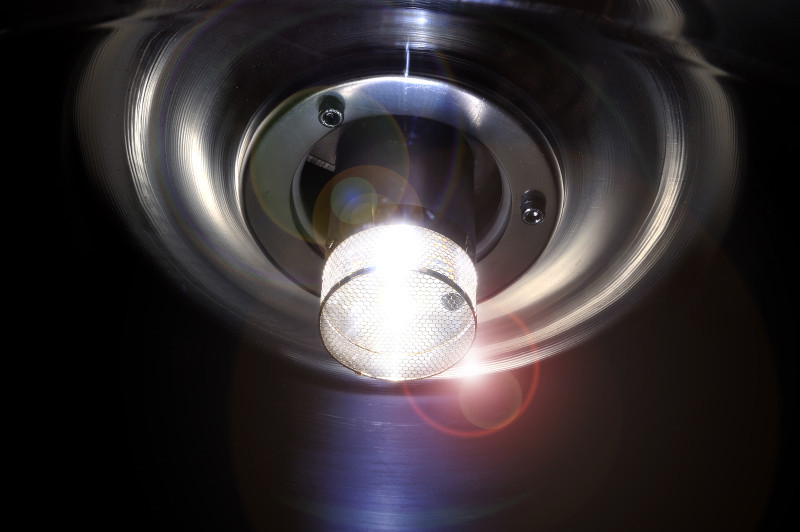
For example, the plasma light source is compact and spherical, which enables precise focusing of optics at the optimal point. In this way the light source and optics enhance each other’s contribution to the overall lighting. In fact, this is quite the opposite to most types of lighting, where the size and shape of the light source actually limits the efficiency of the optical system.
The result is a far more efficient system where so much more of the light produced per watt of electricity consumed is put to practical use rather than being wasted. With HEP, 300W light sources can deliver the same illuminance as 400W HID lamps – or fewer luminaires can be used to maintain the same illuminance. Either way, the installed electrical load is greatly reduced.
Furthermore, the precise optics deliver an exceptionally high light output with no shadows from the lamp and can be supplied with a range of light distributions for different applications. The intensity of the light makes HEP ideal for applications requiring high light output that are traditionally served by HID light sources, such as the high and low bay applications that many Electrical Engineering readers will be familiar with.
HEP luminaires can also be dimmed to 30% of light output for further energy savings. Crucially, the dimming relationship is linear so that, for example, a 50% reduction in light output results in a 50% reduction in energy consumption (dimming of HID lamps is not linear and does not deliver the same energy savings).
Consequently, HEP lighting is very controllable and uses radio frequency (RF) technology to deliver wireless communications between control network and sensors. Because the system uses Internet Protocol, each luminaire and sensor can have their own address on the system and can be accessed from most types of mobile device in common use. The control system also monitors key parameters which feed back to a central control PC.
How it works
The Ceravision HEP system is an electrodeless lighting platform that consists of four integrated elements: a quartz RF resonator and integral plasma burner (lamp); a transition unit (the system which couples the RF energy from the source into the resonator); an RF source in the form of a magnetron and an AC power supply.
The integrated burner and resonator contain an inert gas and metal halide salts. RF energy resonating within the lamp ionises the gas to form a plasma that combines with the metal halide to vaporise the metal halide salts, emitting an intense, bright light that does not need to be corrected with phosphors. The light has a colour rendering index (CRI) of up to 95 and the colour temperature can be adjusted from 2,000K to 12,000K.
Looking ahead
There are now strong indications that the regulations that impact on lighting efficiency, most notably Part L of the Building Regulations, are also moving towards considering the whole package. In fact, this began when efficiency was based on luminaires lumens per circuit watt, rather than simply the wattage of the lamp.
In Part L 2013 it is likely that the Lighting Energy Numeric Indicator (LENI) will be accepted as an alternative to the technology requirement in Part L 2013 and some suggest that LENI will be preferred measure for Part L 2016. So considering the whole lighting package now, rather than just the light source, isn’t just the best way to get a truly efficient system, it is also preparing for the future.