Ben Rooke, senior product manager PV fuses at Bussmann, looks at the importance of fuse development for the solar power market.
In a relatively short time the small PV systems of only a few watts have developed first to a few kilowatts and more recently to as large as 10MW and beyond. During this time a number a number of key changes have occurred to the topography and dimensions of the basic components and indeed the types of components themselves, especially those whose primary function is overcurrent protection.
Looking to the future the trend is to extract greater efficiencies and power from PV installations through new materials and improved insolation technology ie. PV concentrators. The corollary of that will be the requirement for better system overcurrent protection. Already the move globally is for the use of higher voltages of up to 1000Vdc and beyond, in some cases. This has put pressure on PV system OEMs to source and install protection solutions that are not only capable of meeting the protection requirements but can be easily packaged.
It is worth reminding ourselves that in faulted circuits PV modules may be damaged by reverse overcurrents exceeding the reverse current withstand of the modules IMOD_REVERSE. Typically the effects of fault currents may range from permanent damage to PV modules and reduced efficiency to broken conductors resulting in electric arcs and fire. Dangerous fault currents can originate from external sources, ie. from modules or strings of modules that are connected in parallel to the faulted string, from storage batteries in the system or from backfeeding through grid-interactive inverters. However, correctly rated PV fuses are able to protect PV modules or strings and internal wiring against these dangerous reverse overcurrents.
As a manufacturer of fuses we are constantly receiving approaches from PV power supply manufacturers for solutions that meet these challenges. Typically they are looking for certainty and assurances in terms of proven performance and capability. Unlike typical grid connected AC systems, the available short circuit current on a typical PV system is limited and the overcurrent protective device needs to operate effectively on low levels of fault current. To this end we have conducted extensive research and development of devices that are specifically designed and tested to safely protect PV systems with high DC voltages and low fault currents.
The net result of this work is a range of PV fuse links that meet the necessary protection criteria across the system.
At string level, our 10 x 38mm fuse links that meet all the specific requirements demanded by system manufacturers, most notably protection up to 1000Vdc. The Solar PV range offers class leading performance, clearing faults as low as 1.35 x l (fuse rating) @ 1000Vdc and is suitable for industry standard dimensioned 4, 5 and 6in crystalline solar cell based modules and thin film modules.
In addition these fuse links have been tested to withstand the typical cycling conditions specific to solar panel operation and the environmental impact associated with system location. In effect, this means that the fuse will perform to its optimum level for the duration of the system life.
The new range of XL Style, square body fuse links in voltage ratings up to 1500Vdc provide OEMs greater flexibility in the protection of higher power PV arrays. No other fuse manufacturer has achieved this landmark voltage rating in this package, representing a significant breakthrough in fuse design and performance.
The new series of NH1 square bodied photovoltaic fuse links has ratings up to 1000Vdc; these are among the smallest NH style fuse links to achieve this rating and are one of the most comprehensive ranges of NH size fuse link solutions on the market with amp ratings from 50A to 160A.
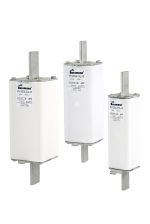 The 14 x 65mm range of photovoltaic fuse links comprises 15 and 20A ratings at 1500Vdc and 25 and 32A ratings at 1300Vdc, making this the only series to offer these voltage and amp ratings in this package size.
Also available is a range of IEC 60269-6 (gPV) 14 x 51mm photovoltaic fuse links. This new ferrule-bodied series comprises 15 and 20A ratings at 1100Vdc and 25 and 32A ratings at 1000Vdc, providing PV system OEMs with a compact protection solution for higher voltage distribution networks.
Packaging is also a key criteria for system OEMs. For example, with space limited in combiner boxes because of the desire to minimise the footprint and improve the overall aesthetic, the preferred dimensions for the fuse link is 10 x 38mm. This globally accepted package size is further enhanced by a choice of mounting options with standard ferrule, bolt and versatile PCB mounts on offer. The low power dissipation of the fuse also contributes to minimum energy loss and heat generation within the combiner box.
The other factor that provides certainty and comfort for OEMs is compliance with standards. However, here the situation is fluid to say the least. Industry expert Dr Herbert Bessei puts it succinctly: “Increasing demand for alternative energy and strong financial support by some governments has boosted the installation of PV power systems faster than commonly accepted rules and international standards could be developed. Many terms, definitions and test procedures are still undefined and used in different ways.”
The existing standard,IEC 60269-6, was published in September 2010 together with UL 2579 which gave the PV industry standards to work with.
Updates to IEC 60269-6 are already being considered to better meet the requirements of the industry, installation codes such the NEC in the USA and IEC 60364* in Europe, together with installation guides for PV systems such as IEC 62548 “installation and safety requirements for photovoltaic (PV) generators”, are also due for publication shortly.
What is certain is that as PV systems evolve with new equipment, new wiring procedures and methods of installation, the development of the PV fuse will continue in tandem. As the asset value of PV energy systems increases, in terms of the revenue that can be generated, it would be wholly inappropriate and commercially suicidal not to protect that asset with a product that meets the necessary performance requirements and standards.
Phone: 00 44 (0) 1509 882 600
Fax: 00 44 (0) 1509 882 794