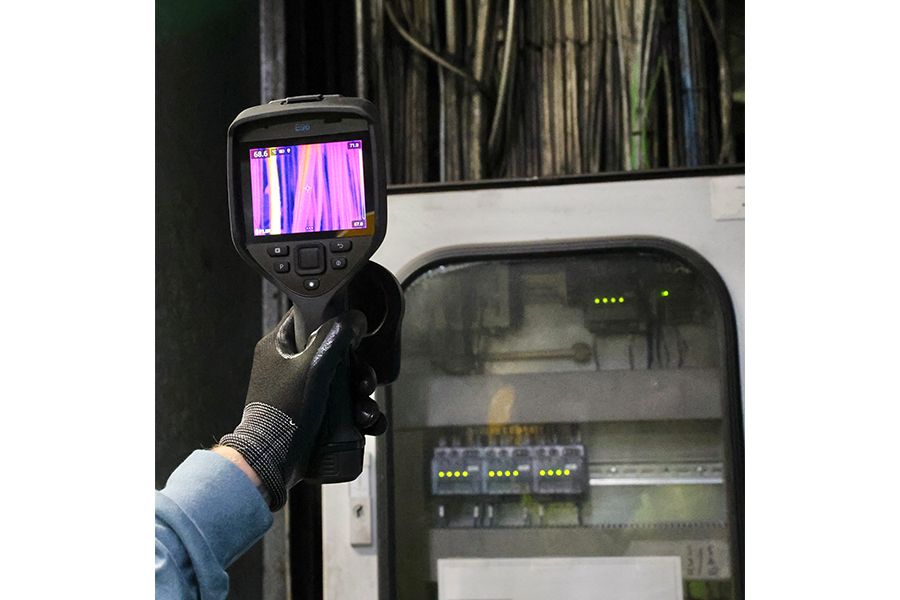
It was once correctly said that fire is a great servant but a terrible master. At one time the majority of property fires were caused by burning coal on open fires and the solid fuel spilling out onto the hearth or floor covering. But that is no longer the main cause of fires in the UK. It may come as a surprise but figures released by the United Kingdom Government reveal that faulty electrical equipment is high on the list of causes when thinking about the dangers of industrial fires. This includes faulty wiring, cabling, and plugs, as well as overloaded power sockets and the use of cheap extension cords. One fire protection company estimates that a quarter of all fires are caused by faulty or incorrect use of electrical items often through overloaded circuits, poor workmanship or a lack of maintenance.
For those responsible for electrical maintenance in industry, ensuring the safety of workers whilst at the same time, the performance and reliability of electrical systems is of utmost importance.
Founded in 1896, the National Fire Protection Association is a non-profit organisation that develops and publishes standards and codes related to fire and electrical equipment that are recognised around the world. They publish two key standards that provide essential guidelines for electrical safety and maintenance practices that can significantly improve both the safety of employees and the reliability of electrical equipment. The two key standards are NFPA 70E and NFPA 70B. The more instantly recognisable of these two standards is the NFPA 70E which essentially improves employee safety by identifying the potential electrical hazard of electrical items and mitigating the risks. It goes onto to describe the appropriate PPE that should be used when working on, or with a particular electrical system. Other aspects of this standard include the importance of training and education before using electrical equipment.
The less well-known standard is perhaps the NMPA 70B standard for electrical maintenance. As of January 2023, NFPA 70B transitioned from being simply a recommendation to being an enforceable standard. As the name suggests, the standard addresses maintenance issues with an emphasis on a structured approach to a predictive maintenance program.
NFPA 70B describes the importance of keeping accurate records of all maintenance activities and suggests a log of inspections to track the performance and condition of their equipment over time. But it also supports the adoption of a condition-based maintenance system by using appropriate diagnostic tools. These can include ultrasound and infrared techniques and thermal imaging methods. Adopting such techniques can detect partial discharge, corona formation, tracking and arcing. This can not only improve safety, reduce the risk of fire etc, but can optimise maintenance and prevent expensive unexpected failures.
Thermal imaging is a process which can become as complicated as you make it, and the initial purchase can be confusing with a selection of brands, price-points, features, specifications, lenses and training possibilities. FLIR are the market leader in thermal imaging, they operate globally and have teams of specialists who are available to demo their range of cameras, to help new users identify which solution is right for them.
Cameras such as the FLIR E76 allow users to determine the temperature hot spots in electrical cabinets or systems using a simple point and shoot non-contact approach.
Those temperatures can be saved in a report or added to a ‘trend’ allowing future temperature readings to be compared against, thus providing an accurate predictive maintenance tool as described in the NFPA 70B standard. When you notice a particular piece of equipment is hotter than other surrounding components, or has a gradually increasing temperature, then it might be worthwhile investigating why the phenomena is taking place!
A big advantage of the FLIR thermal imaging camera range is the built in software that is designed to assist the user in not only conducting the analysis but in the storage and transfer of data. A program called FLIR Inspection Route runs pre-planned routes to help inspectors stay organized when surveying large or multiple locations. As well as being displayed on the high-definition screens on the cameras, FLIR Ignite provides automatic uploading of images directly from the camera to the cloud for easy, secure storage and sharing without the use of cables or SD memory cards.
For more information on the FLIR range of thermal imaging cameras, or if you are completely new to predictive condition monitoring please contact your local FLIR agent or distributor.