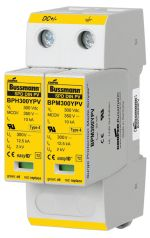
 Cooper Bussmann’s Tony Garlinge-Warren looks at what measures should be considered when protecting PV system components, in particular inverters, from the damaging effects of overvoltage surges
The topic of surge or overvoltage protection can, at times, be misunderstood. Yet the need for it is self evident as industry and commerce relies on devices that are hugely sensitive to overvoltage events such as surges and lightning currents.
PV problems
The major causes of surges in PV systems are overvoltages induced onto the system by inductive or capacitive means deriving from lightning discharges as well as lightning surges. Lightning surges in the PV system can damage PV modules and inverters.
This can have serious consequences for the operation of the system. First, high repair costs, for example those of the inverter, can be incurred, and second, the system failure can result in considerable loss of revenue for the operator of the plant due to down-time.
The effects of a lightning strike can induce surges onto electrical systems as far as 2km away from the point of impact. Therefore, the cause of many system failures is often unknown giving more reason than ever to fit surge protective devices (SPDs). SPDs are installed in parallel to the load and they act as a pressure relief valve by taking access voltage and shunting it to ground, thus maintaining a healthy stream of system voltage to the application.
Obviously coordinating the types of surge protection devices employed (i.e. Class I, Class II and Class III) is key to combating the damaging and disruptive effects of overvoltages.
It is important to understand that a Class I device will provide protection against the high surge voltages and currents induced by direct lightning strikes, but will not protect against the smaller surges of indirect strikes or switching surges.
Attention should be paid to the voltage protection level of the device being used as this is the point at which the device will start to protect as the surge rises in amplitude. For example, in Class I SPDs, the protection level is mostly higher than the dielectric strength of the device to be protected. In such cases a Class II SPD and possibly a Class III SPD must be connected downstream to reduce the protection level to a value suitable for the device.
 Things to consider
In terms of inverter protection there are several important points to take into account. For instance, in inverters with maximum power point tracking (MPPT), PV strings are combined upstream of the inverter and the SPD(s) is/are connected to the linkage point. In inverters with several MPPTs, each input must have an SPD or an SPD combination.
Another important point to consider when selecting a Class II SPD is that most Class II SPD devices use thermal disconnects which in DC applications can generate a DC arc. Once the DC arc is generated it is hard to extinguish, thus creating more damage than protection. In this case the ideal solution is using the SPDs that in addition to MOVs also use a fast acting DC fuse to extinguish the arc and safely disconnect the SPD. This combination of MOV with a fast acting fuse is often referred to as short circuit technology (SCI).
Due to the nature of PV installations which can be in remote locations, it is advisable to use SPDs with remote contacts which can alert the user should a SPD sustain a strike and go offline.
Along with SPDs used on the DC side, SPDs are also required on the AC side due to differences in potential and earthing of the system beyond this point. Unlike on the DC side, several inverters can be protected by one SPD because they are connected to the same (mains) voltage. On the AC output side of the inverter it is important that the SPD device being used is rated according to the system configuration. It is advisable to consult the relevant IEC standard for the possible system types.
When using string circuit protectors and SPDs, the SPD must be installed at the linkage point (combiner box) of the PV strings downstream of the fuses. If the SPD was only to be connected to one PV string between string output and string fuse, the remaining PV strings would be unprotected if the fuse operated.
In addition there would be no protection to the inverter if the surge occurs on the remaining live PV strings. In this event, there would be no protection to the input of the inverter from the remaining strings. Hence it is imperative that the DC SPD devices are positioned in the correct circuit position to provide secure system protection.
Summary
It is often said that prevention is better then cure and given the big investments necessary for PV system build and operation, it seems prudent to invest what is a relatively small amount of money in SPDs to achieve system safety and security.