Electrical relays are part of the early lessons in engineering, but they become quite meaningful once you see how they work in real systems
They are also very common, and you’ll find a relay in control panels, automation equipment, vehicles, and just about any other setup where there’s a circuit that needs to operate safely and reliably.
But what exactly are replays, what do they do, and what are the different types available? That’s what we’ll look at in this guide.
What are electrical relays?
Electrical relays are often thought of just as an automated version of the switches we are all familiar with, but that doesn’t quite capture their complete role. While they rely on the on-and-off mechanism of switches, relays allow one circuit to control another without a direct connection.
They make it possible for a small, low-power signal to operate a completely separate higher-load system. This helps keep different components safe and connected, even when interacting with more demanding circuits.
The ability to link two parts of a system that differ in capacity is what makes relays appear everywhere, from industrial systems to home appliances.
How a relay works inside a circuit
Electrical relays are made up of the control path and the switching element, two parts that work together to ensure safe and reliable electrical power management in all kinds of circuits.
The control path
This is the part of the relay that receives “instructions”, the signal that tells it to act. This part is designed to respond to low amounts of power, as controllers and sensors operate with minimal power. Despite being weak, the signal is enough to energise the entire component and trigger the action that affects a higher-load circuit.
The switching element
This is the part of the replay that actually connects or disconnects the load circuit. When the control path receives a signal, the switching element changes its state. This then allows current to flow through the load or interrupts it, depending on what’s needed.
The main types of relays
It’s good for engineers to understand the differences, as it helps choose the right relay for a circuit.
Electromechanical relays
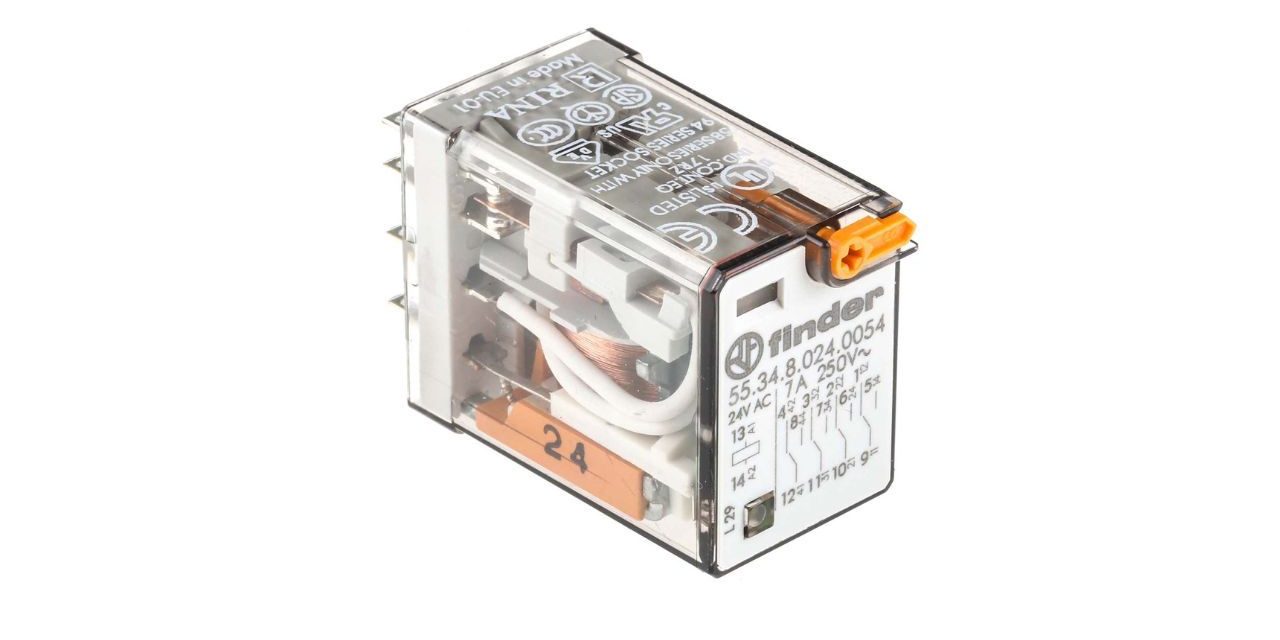
Electromechanical relays, or EMRs, are the first type of relays that were developed. These relays use a coil of wire as the control path.
When voltage is applied, it becomes an electromagnet that can move the relay’s physical arm to connect contacts and complete a circuit. This then allows current to flow through the connected equipment. The same principle is also used when disconnecting the circuit.
These types of relays are usually used in a wide range of applications and can handle a wide range of voltages or currents. They also give an audible click that’s quite helpful in knowing everything is working well.
But while they are reliable and easy to work with, the mechanical movement means that they have a finite lifespan. When choosing one, engineers need to select the right material and probably consider some protective components, depending on the application.
Solid-state relays
Unlike EMRs, solid-state replays (SSRs) don’t have any moving parts. Instead, they use semiconductor switching elements, typically thyristors, triacs, and diodes. These are the parts that determine whether current moves from one part of a circuit to another. The lack of movement within the relay itself means that they operate quietly and are fast. They also last longer than EMRs.
However, their design also means that they generate heat during operation, so it’s important to manage it. The continuous connection can also mean there’s a current leak sometimes, which you need to factor in for sensitive circuits.
That said, these relays are still widely used in applications where high-speed switching, quiet operations, and long operational life are needed. Choose the correct type by trying to balance the trade-offs between speed, load capacity, lifespan, noise, and environmental tolerance.
For more information, visit https://uk.rs-online.com/web/c/relays-signal-conditioning/
To read more from Electrical Engineering, visit our NEWS page