The likelihood is, if you’ve invested the capital expenditure in a backup generator, then you would want that generator to start automatically in the event of a mains power failure. An AMF panel will enable this automatic changeover.
What is an AMF panel?
Automatic mains failure (AMF) panels, often referred to as automatic transfer switch (ATS) panels, make the power switch to emergency standby generators in the event of a significant loss of mains power or total blackout. Without AMF panels, generators need to be operated manually and that can mean lost data, potential damage to electrical equipment, and huge amounts of disruption.
AMF and ATS panels monitor the incoming AC mains supply, activate the standby generator when mains power fails, and make an automatic electrical transfer of the building’s load from the mains to the generating set. When the mains supply returns, the AMF panel controls a return to the mains supply and shuts down the generator after a suitable cooling run.
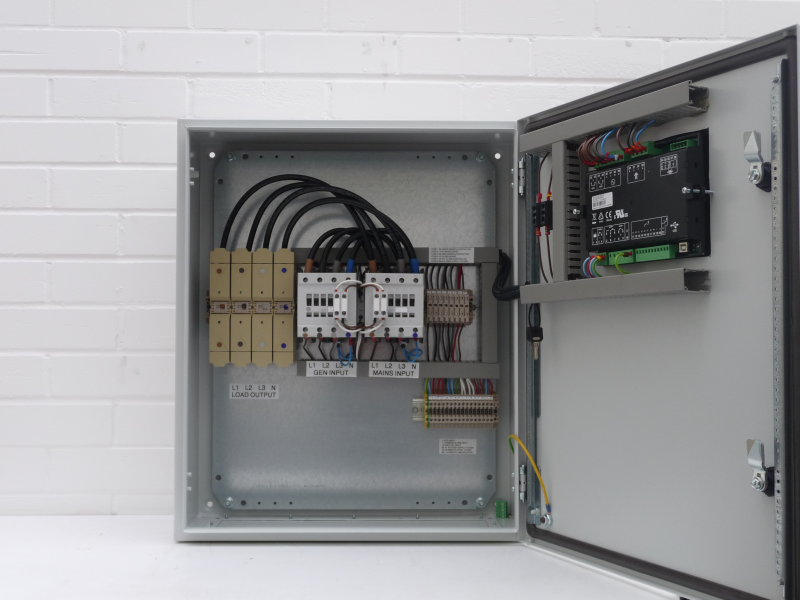 AMF panels in action
A recent shentongroup project showed the use of AMF panels to meet the requirements of a Bristol based IT company. The business required a cost effective relocation of their existing back up power supply.
For an IT company, power continuity is of critical importance. This job required the relocation of an existing 3 phase generator. The new location requirements meant that the existing 3 phase generator had to be modified to support the single phase load at the new site. The new site conditions meant that the generator also required adaptation to support multiple mains supply.
For each mains supply you need an automated transfer switch and associated cabling, so the AMF panels can sense mains supply and start the back-up generator, in the event of a failure.
On site there were two mains supplies to be supported, one of which was split into two, supporting a total of three separate buildings. This allowed shentongroup to use just two AMF panels keeping costs at a minimum. One AMF was located outside in an IP rated enclosure mounted on a plinth and stand, whilst the other was at high level in the building by the mains header it supported. Connections to the external AMF were local to the generator. The second cable run was more involved, being approximately 60 metres running at high level across one building. Then through a cable trench under a drive way, to the building it was supporting.
Find out more about how to choose the right kind of standby power, download shentongroup’s free white paper http://www.shentongroup.co.uk/lp/protecting-your-business-with-the-right-type-of-standby-power/