
When infrastructure projects move through design and into construction, access for future maintenance is rarely on the critical path
Equipment gets specified, civil works get scoped, poles get ordered, and the question of how a maintenance crew will safely reach that lighting fixture or pole-mounted instrument five or ten years from now goes unasked until the asset is already in the ground.
The consequences play out across the life of the asset. Every time pole-mounted equipment needs attention, whether a luminaire replaced, a camera inspected or an instrument calibrated, crews face an elevated access task that could have been engineered out at the design stage. Mobile Elevated Work Platforms (MEWPs), scaffolding, fall arrest systems, traffic management, permit administration: all of it repeated, cycle after cycle, for the life of the installation.
Safety by design addresses this at the source. The principle is straightforward: hazards should be eliminated through design decisions made early, before they become embedded in the infrastructure. For asset owners, engineers and HSE professionals, this reframes access planning as a structural safety obligation, one that belongs in the design phase, not the operational one.
The Hierarchy of Controls Applied to Access
The hierarchy of controls is well established in occupational health and safety. Elimination sits at the top: remove the hazard entirely. Below that come substitution, engineering controls, administrative controls and finally PPE.
In practice, working at height risk associated with pole-mounted equipment maintenance is frequently managed through the lower tiers. Procedures are written, PPE is issued, permits are developed, training is delivered. The exposure itself, the need to climb to reach a lighting fitting, a sensor or a camera, remains unchanged.
This is where design teams have the greatest opportunity to intervene. Applying the hierarchy of controls to access decisions during early design is consistent with sound engineering practice and with the direct requirements of the Work at Height Regulations 2005 in the UK. It is also where the decision is cheapest to make.
The Work at Height Regulations 2005 in the UK
The Work at Height Regulations 2005 apply across all industries and all workplaces in the UK where people are required to work at height. The duty is clear: employers and those who control work must avoid work at height where reasonably practicable, and where it cannot be avoided, must take all reasonably practicable steps to prevent falls.
The regulations place emphasis on prevention through planning and proper equipment, not on managing risk after the fact through procedural controls. For industrial asset owners and engineers, this has a direct implication for how maintenance access to lighting and pole-mounted equipment is approached at the design stage.
Pole-mounted lighting and equipment that requires routine maintenance creates a foreseeable, recurring work at height requirement across the operational life of the asset. That foreseeability is precisely what makes it addressable at the design stage, and what makes deferring it to operational procedure a weaker response than the regulations intend.
Designing out the elevated access requirement entirely, so that lighting and equipment maintenance is carried out at ground level as standard, is the most direct way to meet the duty to avoid work at height where reasonably practicable. It is an engineering decision, and it is most effectively made before civil works are committed.
Why Routine Access Is a Sustained Risk
Falls from height have been the leading cause of fatal workplace injury in the UK for over two decades, accounting for around a quarter of worker deaths in the most recent reporting year. Pole-mounted equipment maintenance sits squarely within this broader category of elevated access work.
Maintenance of pole-mounted lighting and equipment is precisely this kind of task: repetitive, often underestimated and carried out by rotating crews under varying site conditions. Familiarity tends to reduce perceived risk rather than actual risk. Permit processes get abbreviated for jobs that feel routine. Equipment checks get skipped when time is short. The task appears identical to the last one, until the conditions, the crew or the circumstances are slightly different.
The exposure is also cumulative. A single industrial or infrastructure site may have dozens or hundreds of poles carrying lighting, cameras, sensors or communications equipment. Across a maintenance lifecycle spanning 25 years or more, the number of individual elevated access events is substantial. Each one carries the same fundamental risk profile.
What Early Access Planning Looks Like
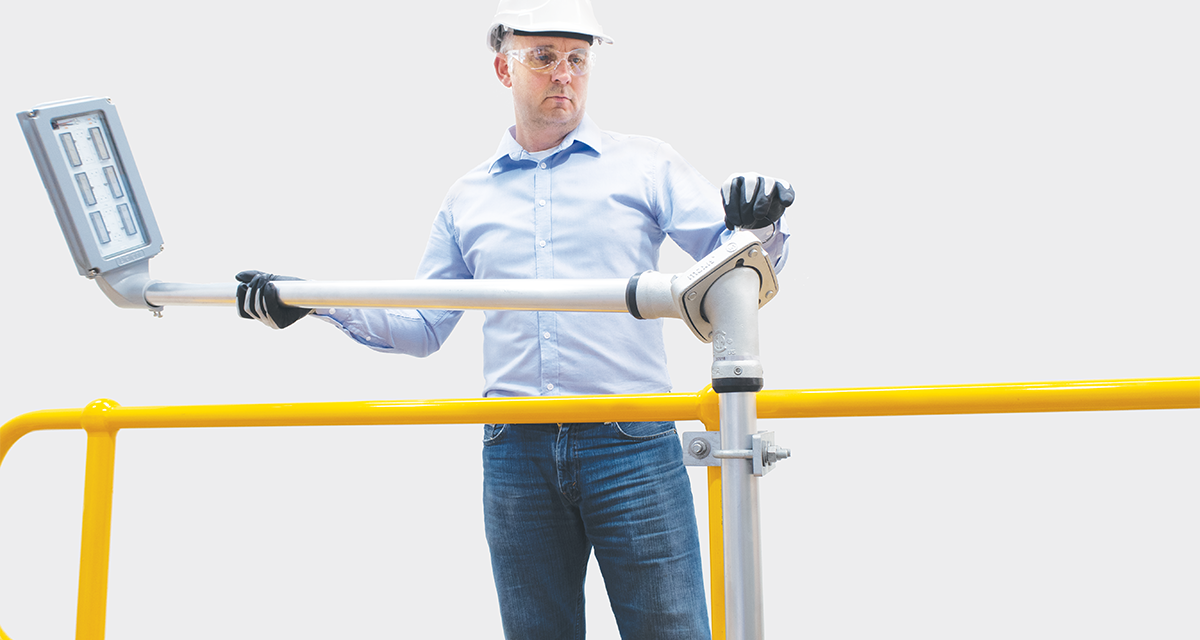
The engineering solution is well established: lowering pole systems that bring lighting and equipment to ground level or walkway level for every maintenance event. No elevated platform, no fall arrest equipment, no additional crew requirement. The access method is built into the infrastructure from the outset.

The decision to specify a lowering pole system rather than a fixed pole is most straightforward, and most cost-effective, when it is made during concept or early detailed design. At that stage, civil works requirements are comparable, installation is similar, and the footprint on site is the same. What differs is the maintenance outcome delivered across the full life of the asset.
Ground-level access does not depend on budget availability at the next maintenance cycle, or on the availability of specialist equipment at a remote or constrained site. The capability is there every time, by design.
For project engineers and asset owners, this question is straightforward to address in early design. It becomes significantly more complex and expensive once civil works are committed.
The Lifecycle Cost Argument
The financial case is more direct than it is sometimes presented. The difference in capital cost between a fixed pole and a lowering pole system is measurable. The difference in ongoing maintenance cost is substantially larger.
Every elevated access event carries direct cost: platform hire, crew time, traffic management, permit administration and associated downtime. On sites with significant numbers of lighting columns and pole-mounted equipment, and across a maintenance lifecycle, those costs accumulate considerably. Asset owners in energy, utilities, water treatment and industrial sectors who have moved to specifying lowering pole systems as standard report safety performance improvement and maintenance cost reduction as the primary commercial drivers. The two outcomes are the same decision.
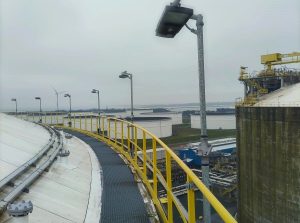
Alinta Energy’s Loy Yang B Power Station in Victoria, Australia, is a useful illustration of the scale this reaches in practice. The site’s existing light poles were rigidly fixed to guardrail stanchions, and much of it is a multi-level layout where ladders aren’t an option. Every fixture replacement meant scaffolding, a scissor lift or a boom lift. Rather than replace the poles outright, the site has converted over 1,200 of them to Swivelpole systems as part of an LED upgrade, with another 1,000 in progress.
It’s worth noting this was a retrofit, not a decision made at design stage which matters, because the UK duty to avoid work at height where reasonably practicable doesn’t stop applying just because the asset is already built. Where the original design missed the opportunity, the hazard can still be removed later, without a full rebuild.
Designing In Access as Standard Practice
Swivelpole is a specialist manufacturer of lowering pole systems, engineered to bring lighting and pole-mounted equipment to ground level for maintenance, eliminating the elevated access requirement entirely. Systems have been supplied across offshore platforms, chemical processing facilities, mining operations and water treatment infrastructure, where the consequences of working at height are well understood and the case for engineering out that risk is well established.
For project designers, engineers and asset owners, the access question is straightforward to resolve during design and increasingly difficult to address afterwards. Bringing it into the design process as a standard consideration, alongside product and vendor specification, structural design criteria and civil works, is the most effective point at which to act. Under the Work at Height Regulations 2005 in the UK, the duty to avoid foreseeable work at height where reasonably practicable begins at the design stage. That is precisely where it is most cost-effective to act on it.
By Amy Olsen, Group General Manager, Swivelpole


