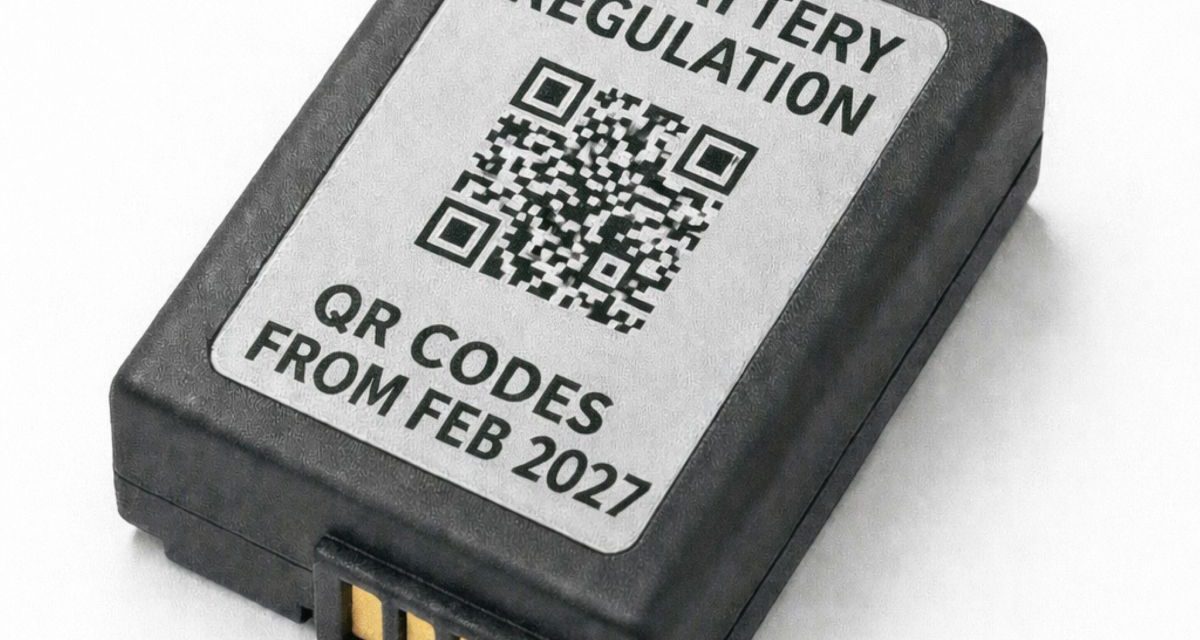
From February 2027, every battery sold in the EU must carry a QR code
Introduced under Article 13 of Regulation (EU) 2023/1542, this change represents a fundamental shift in how battery information is communicated, accessed and regulated. While QR codes are not new in themselves, the scope and regulatory intent behind these rule changes significantly impact both battery and device manufacturers, explains Neil Oliver, senior technical marketing manager at Ultralife Corporation.
It’s important to note that Regulation (EU) 2023/1542 is precisely that – a regulation, not a directive. At over 190 pages, this comprehensive piece of legislation replaces the previous Battery Directive that guided European standards. Unlike a directive, all requirements will apply uniformly across all EU member states.
Article 13 specifically addresses labelling and marking and makes clear that, from 18 February 2027, all batteries must be marked with a QR code (or have it present on the packaging or instructions) providing access to relevant battery information.
Declarations vs Passports
One area of confusion has been the difference between QR codes for declarations and those for passports. Though similar and closely linked, these are not interchangeable. From February 2027, all batteries in the EU will require a QR code linking to a declaration, but only certain batteries will require a full battery passport.
Battery passports will apply to batteries powering Light Means of Transport (LMT), such as e-scooters, segways and small electric bikes. They will also apply to industrial batteries with a capacity greater than 2 kWh and to those powering electric vehicles (EVs). For these batteries, the QR code must link to a digital battery passport in accordance with Article 77 of the Regulation.
Once a battery falls into the passport category, the regulatory requirements become significantly more complex. Battery passports are structured around three layers of information, covering data accessible to the public, data received for market surveillance authorities and the European Commission as well as information intended for parties with a legitimate interest, such as repairers, remanufacturers and recyclers.
While the Regulation defines what information must be provided, it offers limited practical guidance on how access to these layers will be managed in practice.
The information behind the QR code
A full battery passport is unlikely to be needed for most batteries used in commercial, industrial and medical devices. However, there will still be a need to provide information digitally. For these batteries, the QR code must still link to a defined set of data as laid out in Part A of Annex VI of the Regulation.
At a minimum, this includes core product information such as the battery’s manufacturer, category, place and date of manufacture, weight, capacity and chemistry. Information must also be provided on any hazardous substances present, other than mercury, cadmium and lead, along with details of any usable extinguishing agent and the presence of critical raw materials where these exceed 0.1% by weight.
Further information requirements may apply depending on battery type. For example, rechargeable portable batteries, LMT batteries and Starting, Lighting, Ignition (SLI) batteries must provide capacity information via the QR code, while non-rechargeable portable batteries must include details of their minimum average duration in specified applications. Although this latter requirement presents practical challenges, it is explicitly defined in the Regulation and must be addressed.
The QR code must also link to information that has traditionally been communicated through symbols and documentation. This includes the symbol for separate collection, which remains mandatory, and the chemical symbols for cadmium or lead where concentration thresholds of 0.002% and 0.004%, respectively, are exceeded. In addition, the EU Declaration of Conformity referred to in Article 18 must be made accessible digitally, along with the report referred to in Article 52(3), which relates to broader compliance obligations under the Regulation.
Finally, manufacturers must ensure that information regarding the prevention and management of waste batteries is available through the QR code. This content, defined under Article 74(1) points (a) to (f), is intended to support the Regulation’s wider objectives around sustainability, recycling and circularity and must be maintained throughout the battery’s life.
Implications for manufacturers
For device manufacturers, the QR code requirement introduces an extra layer of regulatory responsibility. Under Regulation (EU) 2023/1542, the “manufacturer” is often defined as the entity placing the battery or battery-powered product on the EU market, rather than those producing the battery itself. Consequently, responsibility for QR code compliance may rest with the device manufacturer rather than the battery supplier.
This has practical implications for data ownership, hosting and long-term accessibility. QR-linked information must remain accurate and available over the battery’s lifetime. Therefore, manufacturers must consider how regulatory content is managed, updated and maintained. Furthermore, QR codes must be incorporated into product or packaging design in line with ISO/IEC marking standards, with the Regulation allowing placement on packaging or accompanying documentation where direct marking is not feasible due to size or format constraints.
Preparing for February 2027
It may seem distant now, but February 2027 will soon come around. In the meantime, manufacturers must identify which batteries in their portfolio will require passports and those that only require QR-linked declarations. They must assess what information is already available, where gaps exist and how regulatory data will be hosted in a stable and compliant online location.
Of course, non-compliance brings risks. This could be in the form of corrective action or product withdrawals and recalls – all causing significant damage to manufacturers’ reputations. Early engagement with the Regulation can help manufacturers clarify responsibilities and avoid last-minute compliance challenges.
As a specialist battery manufacturer, Ultralife are actively working with customers to navigate the evolving regulations. While the technical data required under Article 13 is largely understood, structuring, maintaining and hosting that information in a way that meets regulatory expectations over the long term remains a challenge.
QR codes represent a major shift in battery packaging and labelling requirements – and they’re just a few months away from being mandatory in the EU. However, manufacturers still have time to familiarise themselves with the required changes and seek the technical advice required. Even the batteries that do not require full battery passports will need a QR code linking to technical information and documentation – and an experienced battery specialist can make the process easier.
To find out more about battery manufacturing, including regulatory support, visit the Ultralife website or speak to a member of the engineering team
To read more from Electrical Engineering, visit our NEWS page