 Voltage optimisation (VO) is an established method of reducing household energy bills and carbon emissions while refining the quality of power. However, what benefits does it offer to the installers themselves. Geoff Clifton of VO4HOME investigates.
The voltage supplied to most homes in the UK is higher than it needs to be – in the UK mains electricity is typically 242V, whereas appliances are designed to run at 220V. Therefore, electrical installers are increasingly turning to voltage optimisation to expand their service offering in order to provide their domestic customers a quick and easy way to reduce electricity bills that doesn’t involve additional finance or extensive training.
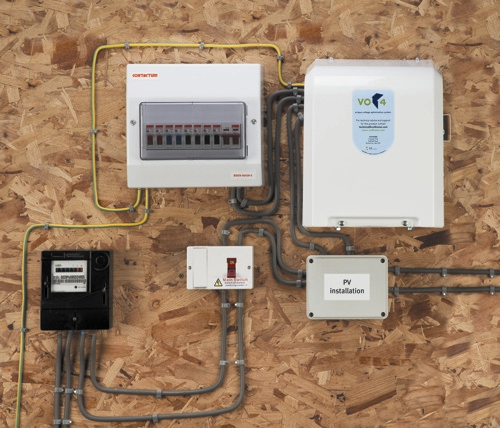
Registered electricians already have all the skills necessary for the installation procedure of VO, which makes it an attractive proposition. Installation takes less than an hour – it simply requires two wires in and two wires out to make it fully operational.
In addition to the energy savings achievable through VO, there are also a number of other often overlooked benefits of the technology. Marginally reduced voltage and the natural attenuation of spikes can have a great effect on appliances, resulting in improved efficiency, lower maintenance costs and prolonging the lifetime of electrical equipment.
In addition, voltage optimisation offers an environmental benefit. By using less energy householders will directly reduce the amount of carbon emissions they produce, and can save around 330-500lbs of CO2 emissions per year.
The law
Some installers still question the usefulness of VO technology, despite the fact that it has been in commercial use for some time. A query often raised is how voltage optimisation relates to Ohms law. Many electricians argue that in lowering the voltage, the current drawn will increase. However, with a voltage optimisation device fitted, appliances will continue to draw the current needed to operate.
In fact, there is a misconception about Ohm’s law that is based on the assumption that electrical loads have constant power and if either current or voltage changes, the other will change to compensate in order to maintain power. However, a reduction in power is what actually occurs.
For example, if we take a load with a constant resistance of 100 Ohms – where Ohm’s law is V=IR – and we suppose that the voltage is 250V, then the equation will be 250 = I x 100. Therefore, the current will be I = 250/100 or 2.5A. Now, consider reduction of the voltage to 220V. As resistance is constant, I now equals 220/100 or 2.2A.
In the first example, Power = Volts x Current, so when the voltage was 250V the Power was 250V x 2.5A or 0.625kW, whereas in the second example the power consumed is 220V x 02.2A or 0.484kW.
The principle of energy saving through voltage optimisation is that effective operation of a device will be delivered at any voltage within a set operating range – which is 216-254V in the UK. However, above a certain optimum voltage, additional energy will be used for no improvement in performance. In essence, a device that is designed to work anywhere in Europe will have an optimum operating point at 220V.
Above this voltage the motor will deliver its rated power, but will use additional energy as heat and vibration. By efficiently removing the difference between the supply voltage and optimum voltage, voltage optimisation brings all equipment to its most efficient operating point without affecting its performance.
Therefore, reducing the voltage reduces the watts consumed by household appliances, and it’s watts that electricity bills are based on, which means that the technology is effective.
A smart choice
Domestic voltage optimisation is very much a win-win situation. As energy users are looking for proven technologies that will deliver cost effective solutions to rising energy costs, whilst simultaneously lowering their carbon footprint without affecting their quality of life, installers are ideally placed to profit from a technology that will deliver on its promises. This makes domestic voltage optimisation a smart choice for consumers and installers alike.