

Manufacturing automation has long relied on the idea that parts arrive in the same position every time, enabling fixed, repeatable processes
In practice, assemblies vary, components shift during handling and tolerances can stack up across multiple parts, creating a gap between expected and actual positioning that is difficult to ignore. Here, Alexander Hale, product manager at assembly tools expert Desoutter, explains why this assumption is becoming harder to sustain as manufacturers move towards more flexible production environments.
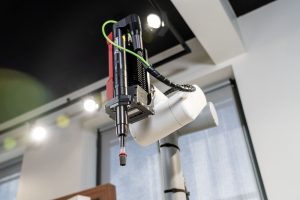
In many production environments, manufacturers have traditionally used dedicated nests, fixtures and carriers to maintain consistent part positioning. This approach can be effective, but it adds engineering complexity and becomes harder to sustain as lines are expected to handle more variants, mobile platforms and less constrained assemblies. Stop-and-go lines are one example where this challenge can appear, but the broader issue is the need for automation to work with the actual position of the part rather than assuming it always arrives in the same place.
While fixtures and carriers are typically used to maintain consistent positioning, many modern production environments are moving towards greater flexibility and reduced reliance on fixed infrastructure. This includes applications using mobile platforms such as AGVs, processes where parts are not fully constrained and assemblies where tolerance stack-ups can affect the final position of holes, fasteners or other features. Traditionally, manufacturers have addressed this challenge by investing significant engineering effort into ensuring parts arrive in exactly the same position for every cycle. As production becomes more flexible, the ability to detect and compensate for real-world variation becomes increasingly important.
As manufacturers shift towards high-mix, low-volume production, the ability to manage positional variation becomes increasingly important. As product portfolios expand and batch sizes decrease, production lines must accommodate a greater variety of components and frequent changeovers. This increases the need for flexible processes, as maintaining consistent part presentation across every variant can require significant engineering effort.
The challenge of maintaining consistency
In these environments, even small positional deviations can disrupt downstream operations. Processes such as tightening and drilling depend on precise alignment at the point of contact, where misalignment can affect tool engagement and final quality.
Alexander Hale, Desoutter
Traditional automation systems were designed to eliminate this variability through fixed positioning, using fixtures and mechanically constrained setups to ensure repeatability. While effective in stable conditions, these approaches become harder to sustain as production requirements evolve and applications introduce greater complexity, such as tolerance stack-ups or components with variable positions.
For example, while a vehicle seat may be held in a fixed location, the position of a moving component such as the backrest can vary, making it difficult to guarantee the exact position of the feature being accessed. This means that even when a part is consistently positioned, the feature itself may still vary in location.
Adapting rigid systems requires significant engineering effort across tooling and control logic. In practice, the limitation lies less in the set-up itself and more in the system’s ability to respond to changing real-world conditions. As manufacturers move towards higher mix production and more flexible automation strategies, maintaining alignment at the point of execution becomes critical. It is no longer sufficient to assume correct positioning; systems must verify and adjust in real time.
In tightening and drilling applications, tool alignment must be accurate before the process begins, as even small deviations can reduce engagement quality, process reliability and consistency. This reflects a broader shift in automation philosophy: instead of forcing parts to match a predefined process, the process must adapt to the actual position of the part.
Recovering alignment in real production conditions
To address this challenge, manufacturers are increasingly integrating perception into execution. Vision-guided robotics enables systems to detect part position and orientation directly within the production environment, calculate positional offsets and adjust movements before performing an operation.
Rather than requiring every part to be presented in a fixed position, vision-guided systems allow robots to locate components in their actual position and adjust their movements accordingly. This reduces the need for tightly controlled fixturing and enables manufacturers to design more flexible production processes.
This is especially valuable in flexible production environments, including applications using stop-and-go lines, AGVs or multiple product variants, where manufacturers need to maintain accuracy without solely relying on fixed positioning.
To bridge the gap between expected and actual positioning, manufacturers are increasingly turning to vision-guided execution systems. Solutions such as Desoutter’s Automated Robot Guidance (ARG) are designed for this purpose. Using a compact, tool-mounted 3D vision system, ARG identifies component position and orientation, detects features such as holes or fasteners and calculates coordinates for accurate robot guidance.
The system processes captured images to identify key features and calculate positioning data, enabling robots to adjust end-of-arm tooling before tightening or drilling takes place. By reducing reliance on complex fixturing and fixed assumptions, ARG enables more flexible and scalable automation in variable production environments.
ARG is designed to integrate easily into existing automation environments. The system is robot brand agnostic and can be implemented across different automation platforms, including robotic and gantry-based systems. Using industry-standard communication protocols, ARG can connect with existing control architectures and integrate with customer or integrator PLC systems. This makes it suitable for both new automation projects and retrofitting existing production setups where greater flexibility and positional accuracy are required.
To learn how vision-guided automation can overcome positional variation and improve accuracy in robotic tightening and drilling, join Desoutter’s free webinar, When Parts Move, Your Automation Should Adapt, on 25 November 2026, from 12:30 to 1:30pm GMT. Register for the webinar here.

