A good system for managing electronic parts is essential, no business wants to waste time hunting for components which are required in a timely manner for customers and production needs.
The requirement to manage thousands of individual electronic components and manage customer expectations means that smarter solutions are required by the industry and running high-mix production is labour-intensive. Time is required to manage the flow of components required to send to customers and the frequent setups and changeovers within the industry. This means that there are high costs in relation to hunting down the right components. This is no mean feat and clarity is required on how best to store, locate, and manage stock.
Traditionally storage cupboards were used to stock small components such as Chips (ICs), and other semiconductors in plastic bags. Larger stock such as passives THT capacitors, SMD resistors, THT resisters and SMD reels needed a more optimised solution. One of the reasons storage has become such an issue within the electronic industry is the speed of change in components and keeping up with constant technological evolution.
Most electrical component failure is caused by excess temperature, excess current, mechanical shock, or impact. A static charge can impact electronic components to the point of failure.
It’s important to have full control over humidity and temperature levels to protect sensitive components. Unit temperatures may range from -25 °C to 60 °C and unit humidity can be reduced by up to 5 %, when necessary. When working with electronics, automation can give you the security to implement solutions that meet industry requirements such as Fire protection, EDS protection, and clean, dust-free storage which in some cases is required.
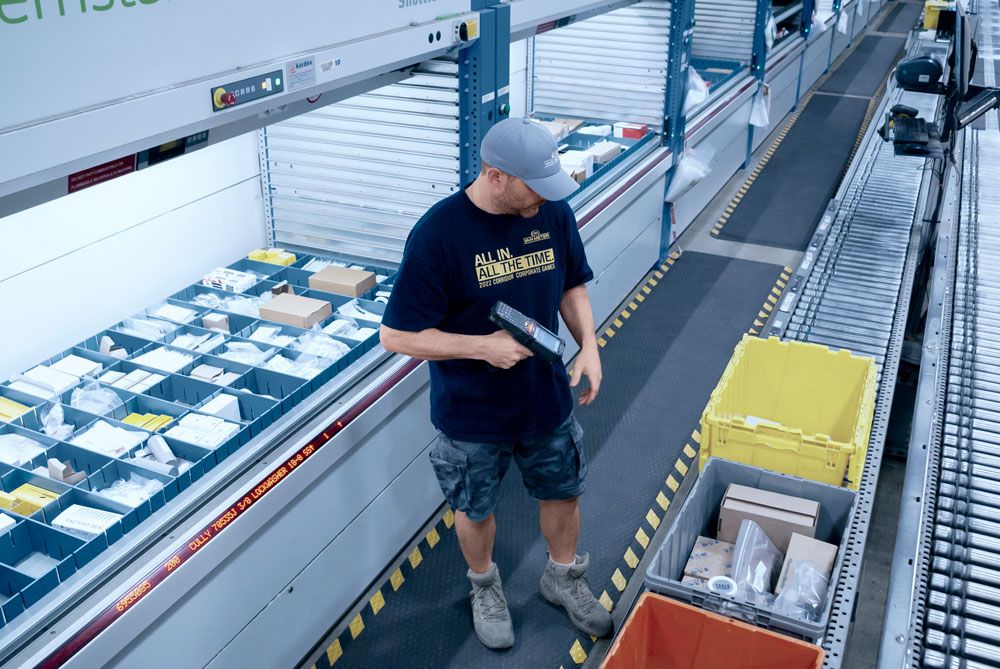
BD Sensors is a manufacturer of electronic pressure measurement devices and they wanted to modernise their environment and increase productivity. The company moved to an automated model to stock their components and operate a pick and pack process at their production plant. They purchased five automated Kardex Shuttle vertical lift systems for fast storage and retrieval of mixed sized/weight components as part of their order picking process which was controlled by a WMS (Kardex PPG) software system. This enabled BD Sensors to reach nearly 100% accuracy and the company increased their number of picks by 50%. They also massively reduced their footprint and were able to reduce the number of operators to two-thirds.
The move to automation increased their productivity, it released space and the software gave them performance data which is delivering transparency and understanding on their orders and transactions.
Kardex has created a pillar page that has lots of links to interesting articles and white paper so to learn more about how automation can benefit your production click here. Or contact Kardex at info.remstar.uk@Kardex.com