Kyocera has developed an innovative mmWave phased array antenna module (PAAM) that simultaneously creates multiple beams in different directions at different frequencies. These PAAMs will be used in 5G FR2 infrastructure installations, enabling for example site co-location of different operators running networks on different frequency bands. To ensure optimal beam steering and beam directivity of their ground breaking product, Kyocera relies on CATR-based multi-reflector OTA testing technology from Rohde & Schwarz.
Kyocera and Rohde & Schwarz will showcase at MWC 2025 in Barcelona the characterization of a novel mmWave PAAM design for FR2 applications. Crucial to the demonstration at the Kyocera booth (5E12) is the R&S ATS1800M 5G NR multi-directional mmWave test chamber from Rohde & Schwarz, designed for over-the-air (OTA) testing with an exceptionally small footprint.
Mobile communications that operate in the FR2 frequency range experience a high path loss, something that can be solved by using beamforming antenna arrays. In contrast to traditional antennas, FR2 antennas typically use phased arrays with a high number of individual antenna elements. Kyocera has developed a novel phased array antenna module (PAAM) featuring 384 dual polarisation elements which is able to create up to 8 simultaneous beams in different directions at different frequencies. With this design, the PAAM can be used in site installations allowing multiple operators to run networks on different frequency bands.
However, all these antenna elements need to work perfectly together to form an RF beam with the desired characteristics. Rohde & Schwarz offers a patented approach for testing such a complex antenna array over-the-air (OTA) in a fully shielded environment, which helps engineers verify the correct beam pattern and supports the process of minimising sidelobes.
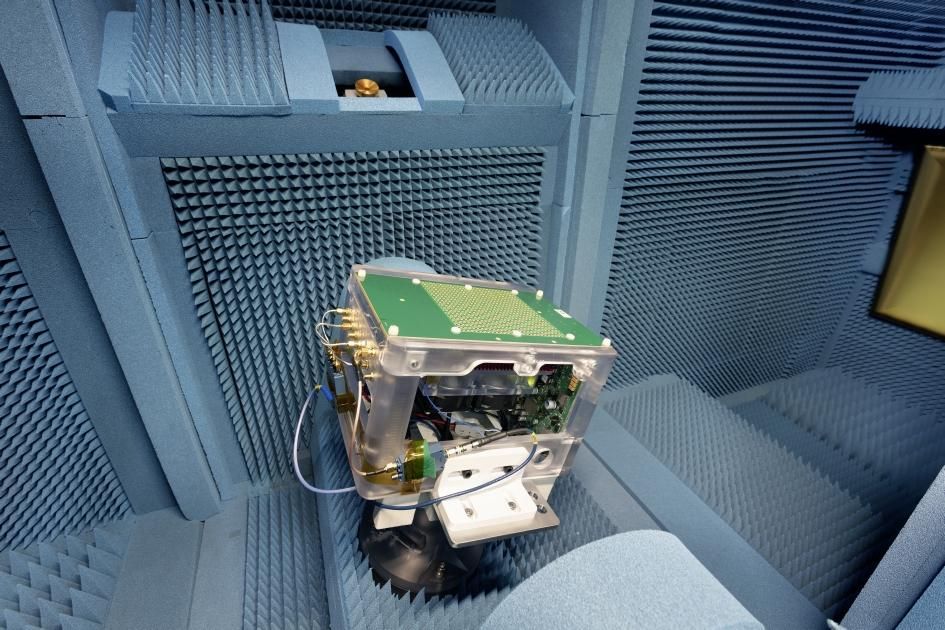
The R&S ATS1800M is a unique solution that features four feed antennas and CATR reflectors, each with a 30 cm quiet zone (QZ). In the demonstration at MWC 2025, the Kyocera PAAM device under test (DUT) is placed on a rugged 3D positioner in the centre, where all four QZs overlap, coming from multiple directions.
This allows Kyocera’s engineers to address a variety of different tests, including the simultaneous reception
of RF beams from four different directions, as will be shown at MWC 2025. Thanks to the vertical CATR
design patented by Rohde & Schwarz, this setup takes up a fairly small footprint in the lab compared to other
OTA-solutions.