
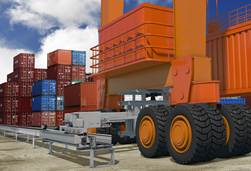
 Cable management specialist igus has developed its e-rover to supply Rubber Tyred Gantry (RTG) cranes with both electrical power and data. This allows the RTG to switch from diesel power to electrical power, saving thousands of pounds per year in diesel costs.
RTG’s are typically diesel powered enabling them to run independently around the port. This has a high cost both in the diesel fuel but also in pollution (both emissions and noise) which ports are also trying to minimise.
RTG’s often work for a large period of time in a straight line in one container “stack”. This offers the opportunity to have an electrically powered RTG with a linear electrical power supply, which would reduce diesel costs and emissions. The downside of a completely electrically powered system is that the crane would then not be able to drive anywhere else, for example between stacks or to other parts of the port.
The e-rover system from igus offers the best of both worlds – electrical power and control whilst working in a stack, and independent diesel power for moving between the stacks
The e-rover system is made up of an energy chain system which can supply the crane with any different media type (electrical power and data, fibre optic cables, fluids, etc.). Thanks to the easy access of the energy chain, different cables and hoses can be quickly added or upgraded. The igus energy chain is made of high performance polymers, so is low friction, self-lubricating and corrosion free.
The energy chain is contained in a single compact guide trough system fitted at the side of the stack, and can work over travel lengths of up to 800m. igus energy chain systems are already well proven in thousands of other port crane applications around the world.
The key to the e-rover system is a fully automatic coupling and uncoupling system which connects the energy chain system to the crane, requiring no manual intervention to go from diesel to electrical power and back again. The system engages both mechanically to tow the energy chain and also the power/data connectors. This means that in under a minute, the crane can go from independent diesel operation to quiet and efficient electrical operation as it moves into the stack.
Initial indications show that by converting machines to electrical power this could show a saving on running costs of more than 40% per year.
