
 Reducing energy consumption and its associated costs is integral to the future development of many organisations, and a major focus of that is lighting. Here, Stewart Langdown of Ceravision looks at all the factors that make up an efficient lighting system
It is common that when the conversation turns to lighting efficiency, the spotlight often falls on the light source. For example, there has been copious amounts of publicity surrounding light emitting diodes (LEDs), so much so that you could be forgiven for thinking that LED lighting is fast becoming the only game in town.
However, while it is undoubtedly a very good light source in the right application (below 150W), it is certainly not a universal panacea, and unfortunately, there are attempts to use LEDs in quite inappropriate ways.
Forward thinking
Essentially the light source is only one element that needs to be considered when trying to achieve lighting efficiency. The majority of luminaires include a range of components from different manufacturers – lamps, control gear, reflectors, diffusers etc. Some are compatible with others and will be capable of functioning together. However, it is often found that they lack the synergies to enhance each other’s performance. And getting one of the components wrong can have disastrous effects on the whole system.
Looking at the whole system and how it’s used is therefore vital. In fact, this is the basis of the Lighting Energy Numeric Indicator (LENI) that will be accepted as a measurement of luminaire efficiency in Part L of the Building Regulations 2013. The important thing about LENI is that it takes account of the luminaire efficiency and the way the lighting is controlled.
Cleary this ‘systemic’ approach makes a lot of sense because it puts the lighting in the context of the application. In fact, you could say it’s based on the sound engineering principles that readers of Electrical Engineering routinely apply to their work.
HEP
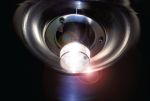
These principles can be illustrated by considering a relatively new type of lighting called high efficiency plasma (HEP), which is particularly well suited to applications requiring high light output such as high bay street lighting etc. It also has the potential to reduce energy consumption considerably as 300W HEP luminaires can deliver the same illuminance as 400W HID lamps.
As noted at the beginning of this article the light source is important but not the be-all and end-all. In the case of HEP, this is a spherical, compact light source that enables precise focusing with no shadows from the lamp, so that the light source and the luminaire optics work in harmony. The result is that it is easier to achieve precise light distribution. This means that fewer luminaires can be used to achieve the same illuminance as HID luminaires.
HEP luminaires can also be dimmed to 30% of light output. Crucially, the dimming relationship is linear so that, for example, a 50% reduction in light output results in a 50% reduction in energy consumption (dimming of HID lamps is not linear and does not deliver the same energy savings).
Keeping overall performance very much in mind, HEP lighting is also highly controllable, using radio frequency (RF) technology to provide wireless communication between sensors and the control network. The control network uses internet protocol (IP) which can be accessed using a range of mobile devices such as smart phones and tablet computers.
Each luminaire and sensor has its own IP address for highly flexible control, as well as monitoring of key parameters such as burning hours, light output over time and energy consumption. The system can also be used in conjunction with other IP-based technologies, such as RFID (radio frequency identification) tagging.
HEP lighting also tends to be very reliable as there are no wiring connections to the light source that might be the cause of premature lamp failure – an important consideration in high bay lighting where access is difficult and disruptive. Instead, this electrodeless system uses an integrated burner and resonator containing an inert gas and metal halide salts. A quartz RF resonator is used to ionise the gas to form a plasma that combines with the metal halide to vaporise the metal halide salts – emitting an intense, bright light that does not need to be corrected with phosphors.
Summary
So, with HEP what we have is a lighting system that exploits the strengths of light source, luminaire and controls in the context of the application. As such it demonstrates the benefits of a ‘system thinking’ approach that reflects the actual performance of the lighting in-situ, rather than the theoretical performance of a light source that may be impacted by other factors.
As with any lighting technology, HEP is particularly suitable for certain lighting applications and won’t be the best solution for others. And really, that’s the key point – choosing the best technology for each project.
Ceravision
T: 01908 371 463